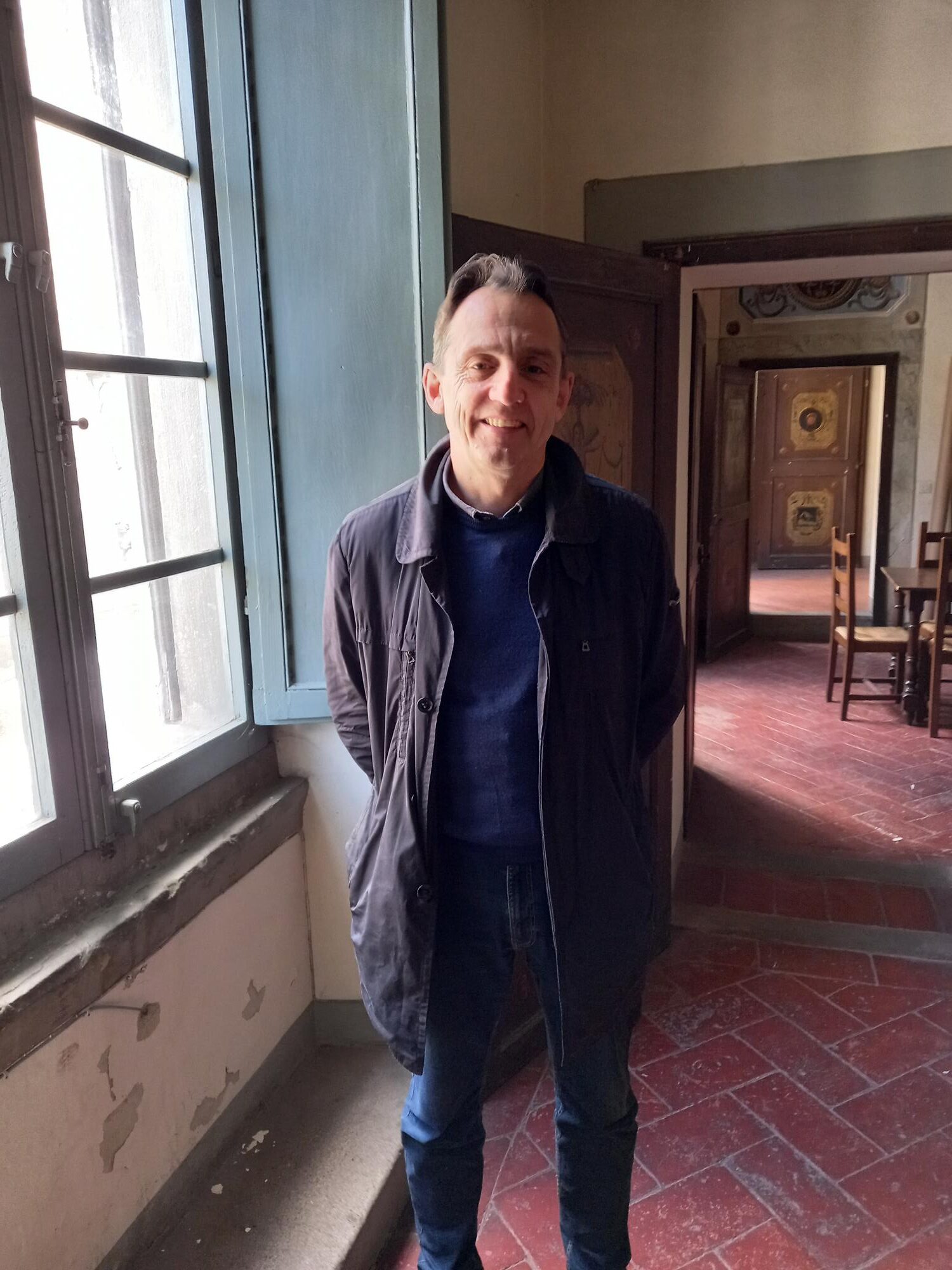
Appartenenza ad Anghiari – Paolo Carbonaro
Paolo è il direttore del centro per anziani di San Lorenzo a Sansepolcro. Me l’ha presentato Angela, la giornalaia, che lo vede ogni mattina quando passa da lei per comprare il giornale mentre va al lavoro e che ha pensato che sarebbe stato interessante per me fargli un’intervista. Sono molto grata a lei per questa presentazione e a Paolo che, nonostante i suoi gravosi impegni, ha trovato il tempo per parlare con me.
Ho intervistato Paolo nell’ACS (Anghiari centro studi). L’intervista condotta in italiano è stata poi trascritta e tradotta in inglese da Mirella Alessio. Questa è una versione editata.
Io sono nato il 28 maggio 1971 a Città di Castello a pochi chilometri da qua, ma sono da sempre vissuto a Sansepolcro. Siamo una bella famiglia, ho 2 fratelli, Marco ha un anno più di me, è del ’70, Giovanni è nato nel 1979 e una sorella Anna nata nel 1989. Mio babbo ha lavorato come impiegato prevalentemente in una ditta di trasporti, mia mamma in un ufficio in ospedale. I genitori stanno bene tutti e due.
Ho fatto elementari, medie e ragioneria a Sansepolcro, mi sono laureato in Sociologia a Urbino. Un anno importante per me fu il 1992: invece del servizio militare ho fatto il servizio civile, feci assistenza ad anziani e bambine con handicap anche importanti e così conobbi la Caritas di Sansepolcro. Da lì è iniziato, tanti anni dopo, il mio lavoro. La decisione di studiare sociologia… mi piacevano gli studi umanistici e l’anno in cui feci l’obiettore mi fece fare delle esperienze importanti, conobbi ragazzi che facevano l’università che mi appassionarono come non prima alla lettura, ma ho visto che anche il servizio civile mi piaceva molto, mi dava soddisfazione stare con persone che avevano bisogno di assistenza.
Nel 1999, a 28 anni, iniziai a lavorare in una casa di riposo per la cooperativa per cui lavoro ancora oggi. Mi piaceva dare assistenza fisica materiale: alzarli la mattina, lavarli, ma anche offrire vicinanza, ascolto, stare insieme. L’importanza dell’ascolto… credo che sia uno dei bisogni principali di ognuno di noi, sentirsi ascoltato, accolto, stimato, benvoluto. In una casa di riposo sei una delle persone più vicine, un lavoro che mi dava piacere farlo, lo facevo con molta soddisfazione.
Dal 1999 al 2004 ho fatto l’operatore addetto all’assistenza ma poi nel 2004 scelsero me come direttore della RSA, avevo 33 anni. Sono direttore di San Lorenzo, detto anche Schianteschi, con sede principale a Sansepolcro, nel centro storico, Villa Serena e Santa Marta, a Porta Romana, il centro diurno che era delle suore di clausura, una struttura per adulti con lievi disabilità, non sono poi tanto lievi, hanno disturbi psichiatrici importanti, depressioni, prevalentemente seguite anche dal Distretto di Salute Mentale.
Noi nasciamo, siamo figli del movimento del volontariato iniziato intorno al 1986. C’era questo gruppo di donne di Sansepolcro, molte cassintegrate della Buitoni che non potendo più lavorare si son messe insieme con persone carismatiche, il vescovo don Giacomo Babini e suor Giuseppa Garrido, una suora spagnola della Misericordia. Crearono questo gruppo di volontariato che iniziò a portare gli anziani d’estate a fare le vacanze nelle vicine campagne e poi una volta alla settimana si trovarono per fare festa allo Schianteschi. Andavano all’ospedale di Sansepolcro, nell’ora dei pasti, a fare compagnia, assistere, dare da mangiare. Nel 1997 nacque una cooperativa di soci Onlus, non a fini di lucro, i servizi aumentarono, inclusero il centro diurno e non bastava il volontariato. Allora, si era all’inizio, con 8- 9 soci, oggi siamo più di 90 soci lavoratori. Il volontariato continua sempre, ma sono due realtà separate, ma che lavorano insieme.
Mi manca il rapporto stretto con le persone che assistiamo, ma ora mi devo occupare più degli ingressi, dei famigliari, coordinare il lavoro degli operatori. Ma ho sempre ho un rapporto molto personale con gli anziani, mi vedono, mi salutano, mi fanno festa, anche io saluto gli anziani, specialmente quelli del diurno che sono più vicini a dove lavoro. Per me è importante l’ascolto, la vicinanza, una parola.
Si diceva una volta che in questi tipi di lavoro bisogna mantenere la giusta distanza, invece no, bisogna avere la giusta vicinanza, per aiutare noi stessi e gli altri. Non è facile fare il nostro lavoro, non è per tutti, ci va la giusta sensibilità.
In questo lavoro si impara l’importanza del dare: io ho avuto la fortuna di venire da una famiglia di fede, nonna Vilma, zia Maria, persone con una fede importante, probabilmente mi hanno lasciato qualcosa di importante. Mio babbo, Vincenzo, è un uomo generoso, di grande integrità, fortemente dedicato alla sua famiglia. Mia mamma, Gemma, mi ha insegnato molto, è ancora molto attiva… la sua generosità la dimostra con la sua vita… è nostro solo ciò che diamo agli altri, diventa più vivo.
La fede ha sempre avuto un ruolo importante nella mia vita e nel mio lavoro, chiedo al Signore che mi aiuti tutti i giorni. Sono sottoposto nel mio lavoro a tante criticità, è importante chiedere aiuto per accettare le cose della giornata. Devo andare preparato, non siamo mai pronti, però ti dà qualcosa in più, le nostre forze umane sono limitate, possiamo fare la nostra parte, ma possiamo ben poco rispetto ai risultati. Io sono sempre stato vicino alla parrocchia, faccio parte del coro, siamo amici con don Alessandro.
Una cosa speciale di Anghiari è la quantità di associazioni di volontari, dalla bicicletta con l’Intrepida, la Pro Loco, il Carnevale, domani c’è la festa dell’Ascensione, sono molti i volontari che partecipano, la Misericordia, il 29 giugno, giorno dei Santi Pietro e Paolo, si commemora la Battaglia di Anghiari, ogni 5 anni la Scampanata, il gemellaggio estivo con la Southbank Sinfonia, gli inglesi vengono a suonare qua perché c’è un terreno che accoglie gli stranieri.
Per quel che riguarda il futuro… i giovani vivono un momento difficilissimo, noi eravamo molto più fortunati, si stava bene, c’era ancora il boom economico, la nostra vita era più semplice, andavamo a scuola stavamo insieme con gli altri ragazzi, giocavamo al pallone, una vita molto concreta, molto reale. Non dipende da loro, ma questa vita social virtuale è molto più individualistica, sotto il giudizio degli altri. Vedono un mondo brutto, di arroganza, l’uso delle parole divisivo che vuole prevaricare l’altro. Noi dovremmo aiutarli, non ritirarci, farli uscire di casa, con i loro amici, aiutarli a creare, a costruire insieme per capire che la vita è fatta di relazioni.
Abbiamo avuto nei giorni passati quatto ragazzi di 17 anni, due ragazzi e due ragazze, che hanno fatto l’indirizzo socio-sanitario. Hanno fatto un servizio bellissimo di due settimane, hanno portato iniziative, sono stati in ascolto degli anziani, interessati, sicuramente da noi hanno trovato un terreno fertile che li ha accolti.
Noi siamo fortunati ad avere don Alessandro, un sacerdote giovane che conosce la realtà del posto, che è nato qua. Sta facendo un bel lavoro, il Giornalino, l’oratorio… però anche lui come tutti deve essere aiutato, è meglio coinvolgere tante persone. A Sansepolcro hanno creato un oratorio aperto durante le giornate come ad Anghiari. Sono ambienti dove non c’è la competitività, vieni accolto, valorizzato, stimato per quello che sei, sono ambienti favorevoli per la crescita della persona.
Io e mia moglie ci siamo sposati il 16 luglio del 2000. Ci siamo conosciuti da giovani a vent’anni a Sansepolcro andando a ballare insieme, frequentando gli stessi luoghi, ci ha unito anche un percorso di fede, tramite le suore del Cenacolo di Montauto, che non ci sono più, ci hanno unito molto, come visione della vita. Abbiamo un figlio, Pietro, ha 23 anni, sta studiando Lettere a Firenze, sta finendo il terzo anno, poi andrà a Bologna, adesso sta con noi. Io mi son trasferito qui quando mi sono sposato perché mia moglie viene da una famiglia di origine contadina che sta ad Anghiari.
Mia moglie fa la maestra di religione ad Anghiari, è molto appassionata e io mi ritengo molto fortunato che abbia accettato questa mia disponibilità al lavoro.
Vorrei ringraziare Mirella per una collaborazione molto congeniale.
Belonging in Anghiari – Paolo Carbonaro
Paolo is director of the San Lorenzo centre for the aged in Sansepolcro. I was introduced to him by Angela, the newsagent – every morning, Paolo drops by there for a paper on his way to work and Angela thought I would find him interesting to interview. I am very grateful to her for the introduction and to Paolo, given his demanding commitments, for finding time to talk with me.
I interviewed Paolo in the ACS (Anghiari centro studi). The interview was conducted in Italian, and transcribed and translated into English by Mirella Alessio. This is an edited version.
I was born on the 28th May 1971, in Città di Castello, but we lived in Sansepolcro. We are a nice family… I have two brothers – Marco, a year older than me, born in 1970 and Giovanni, born in 1979 – and a sister, Anna, born in 1989. My father worked mainly in a transport company, and my mother, in a hospital office. They are both well.
I went to school in Sansepolcro and then I graduated in sociology at the University of Urbino. 1992 was an important year for me – I was a conscientious objector, so, instead of military service, I went into the civil service, assisting old people and girls with a severe handicap, and I came into contact with Caritas in Sansepolcro. That was the starting point of my present career. I had decided to study sociology because I loved the humanities, then during that year I had important lived experiences – I met university students who made me passionate like never before about reading, studying, but I also realized how much I enjoyed being with the aged and people in need of assistance.
In 1999, at the age of 28, I started working in a nursing home in Sansepolcro run by the same social cooperative for which I still work. I really liked taking care of people in a practical way … getting them up, bathing them …but also offering them closeness, togetherness, listening…. Listening is so important, I believe it is one of our main needs – feeling listened to, welcomed, esteemed…. In a nursing home, we are the closest people…. I liked that job, I did it with great satisfaction.
I had that position as a care worker from 1999 to 2004, but then, in 2004, they chose me to direct the nursing home – at 33 I was a very young director. I am still the director of San Lorenzo (also called Schianteschi), located in the historical centre of Sansepolcro – the nursing home, Villa Serena, and the day centre in Santa Marta. The day centre belonged to cloister nuns in Porta Romana; it is for adults with a light disability, actually not that light, because they are supported by psychiatric services – they suffer from depression and more or less serious psychiatric disorders.
To give you some background to the cooperative and San Lorenzo: we are children of the volunteering movement that began in 1986. There was this group of volunteers, women from Sansepolcro, many furloughed from Buitoni, they couldn’t work anymore, they got together with charismatic figures in Sansepolcro, the bishop, Don Giacomo Babini, and sister Giuseppa Garrido, a Spanish nun of Misericordia. This group started taking old people on holidays in the countryside in summer and, then, once a week, they had parties in Schianteschi. They also went to the Sansepolcro hospital at meals times, to feed and assist, to keep company, offering a word, comfort, a presence. In 1997, they founded the social cooperative, a non-profit organisation – with the expansions of services, including the day centre, the volunteers themselves were not sufficient. At that time, we were 8,9 members, now there are more than 90 working members … it is an organisation close to but separate from the volunteering group.
I am missing the direct contact with the people in our care … now I am in charge of admissions, families, I coordinate the work of our employees. But I still have a personal rapport with the old people… they say hello, they are happy when they see me. And I say hello to our guests, especially those in the day centre which is close to my office. It is so important to listen, to be close, to have a word.
Once, we used to say that, in this kind of work, you need to keep the right distance, but, on the contrary, I think we must have the correct closeness … to help others and ourselves. I can’t identify too much with the other, I have to stay close in the right way. It is not easy to do, our job … one needs the right sensibility, it is not for everyone.
In this work you learn the importance of giving. I had the good fortune to come from a very religious family – my grandmother, Vilma, my aunt, Maria, they had a strong faith, and probably they passed something important down to me. My Father, Vincenzo, is a generous man of great integrity, dedicated to his family. My mother, Gemma has taught me so much. She is still very active … it is her generosity, she demonstrates that with her life – it is what we have to give to others that gives us a sense of life.
Faith has always played an important role in my life and my job – it is an important support, I ask the Lord every day to help me. I have to deal with many challenges in my working days, it is important to ask for help to accept these – I must go to the office prepared …we are never prepared really, but it gives something extra – our human strengths are limited, we can only do our share, but we have very little influence on the final results. I have always been close to the parish, I sing in the choir, I am a friend of Don Alessandro.
Something special about Anghiari is the number of volunteer associations – Intrepida for cyclists, Pro Loco, Carnival, tomorrow is Ascension day in which many participate, on the 29th of June, Saint Peter and Paul day, we commemorate the Battle of Anghiari, every 5 years there’s Scampanata, and there’s the Filarmonica…. In summer, the Southbank Sinfonia comes to play here because this is a land that welcomes foreigners.
With regards to the future … young people are living through a very difficult moment – we were more fortunate, we grew up in the boom years, our lives were easier, we went to school, played ball with our friends … a very real life. It is not their fault, but this virtual social life is more individualistic and puts them under public scrutiny, judgement. They see an ugly world of arrogance, divisive language that denigrates others…. We need to help them, not give up … help them come out of their houses, go out with friends, build together, create – life is made of relations.
Recently, 4 students worked with us, 2 boys, 2 girls, 17 years old, attending a technical school for health and social care workers. They have done an amazing job – they took initiative, they listened to our guests, were interested … and, of course, they found a fertile soil with us, we welcomed them.
We are lucky to have Don Alessandro – he is young and he was born here, so he knows this reality. He is doing a good job in the parish Giornalino, the oratorio, but he, like everyone, needs help – it is better to involve many people. There is also an oratorio in Sansepolcro, open during the day. These are environments where there isn’t any competitiveness, young people are welcomed, appreciated for who they are – they are favourable environments for the growth of a person.
My wife and I married on the 16th July 2000. We met when we were young, we were 20, we lived in Sansepolcro, went dancing, hanged around in the same places…. Then, as we grew older, we followed a faith path with the nuns of the Cenacolo di Montauto (they are not there anymore) – they gave us a shared vision of life. We have a son, Pietro, 23, who is attending university in Florence, studying humanities; he is finishing the 3rd year after which he will move to Bologna. At the moment, he is living with us. I moved to Anghiari when we got married because my wife’s family – from a farming background – live here.
My wife is a teacher of religion in the primary school in Anghiari. She is passionate about her work, and I consider myself very fortunate because she has accepted my dedication to my work.
With thanks to Mirella for a very congenial collaboration.
Wonderful inspiring interview. Thank you, all.
I read this keeping in mind that in most recent months I had to move my mother (93 yrs old) into a nursing home (casa per anziani). It was one of the most difficult decisions my brother and I had to make as her children. But it is because she is there (and very happily so), and consequently I am also part of it, that I am now understanding how a nursing home truly is a microcosm of a village life and what it takes to run such a microcosm.
A truly inspiring interview – one can feel the care and dedication to his job.
What a lovely man!
Thank you all for your comments. Yes, Paolo is a truly inspiring man – I was close to tears by the end of that interview.
‘you need to keep the right distance, but, on the contrary, I think we must have the correct closeness … to help others and ourselves.’
In this world where words have so much power, it is refreshing to see there are amazing people who change the narrative with a singe sentence.
Your beautiful heart and your strong mind have translated his soul into beautiful words.