Quest’anno ho condotto le mie interviste al Palazzo Fontana, la sede di Anghiari Centro Studi. Ecco la descrizione di ACS di Renato Li Vigni:
ANGHIARI CENTRO STUDI
Tra cielo e terre di Toscana APS
Con una visione della cultura come locomotiva di sviluppo dei piccoli borghi dell’Appennino, valorizziamo il patrimonio del territorio per un futuro migliore delle prossime generazioni, incrementando la cultura dei cammini e del turismo di prossimità: diffondiamo strumenti quali la video narrazione e la cultura cinematografica. ANGHIARI CENTRO STUDI Tra cielo e terre di Toscana APS, nata nel 2017, è un’Associazione di promozione sociale e culturale, apartitica, no profit, iscritta al registro del Terzo Settore.
COSA FACCIAMO
– VIDEONARRAZIONE E CULTURA CINEMATOGRAFICA: Laboratorio permanente di video narrazione, corsi, rassegne e incontri per diffondere la cultura cinematografica.
– IL TERRITORIO DELL’APPENNINO ARETINO-EMILIANO-ROMAGNOLO: Laboratorio permanente di scienze del territorio a cura del Professor Carlo Citter, Topografia Medievale / UniSI, ricerca e valorizzazione dell’area archeologica di Sestino Romana, studio della rete dei cammini e delle vie della transumanza (Comuni di Sarsina, Verrucchio, Badia Tedalda, Sestino, Anghiari, Monterchi, Sansepolcro).
– I FONDI LIBRARI: nella nostra sede di Palazzo Fontana ad Anghiari, ospitiamo, conserviamo e valorizziamo due importanti fondi librari: Maurizio De Benedictis, storia e critica del cinema e Giovanni Caselli, scienze storiche del territorio, antropologia e archeologia del paesaggio, con annesso vasto patrimonio documentale: riutilizziamo e valorizziamo gli edifici storici in cui hanno sede le nostre attività.
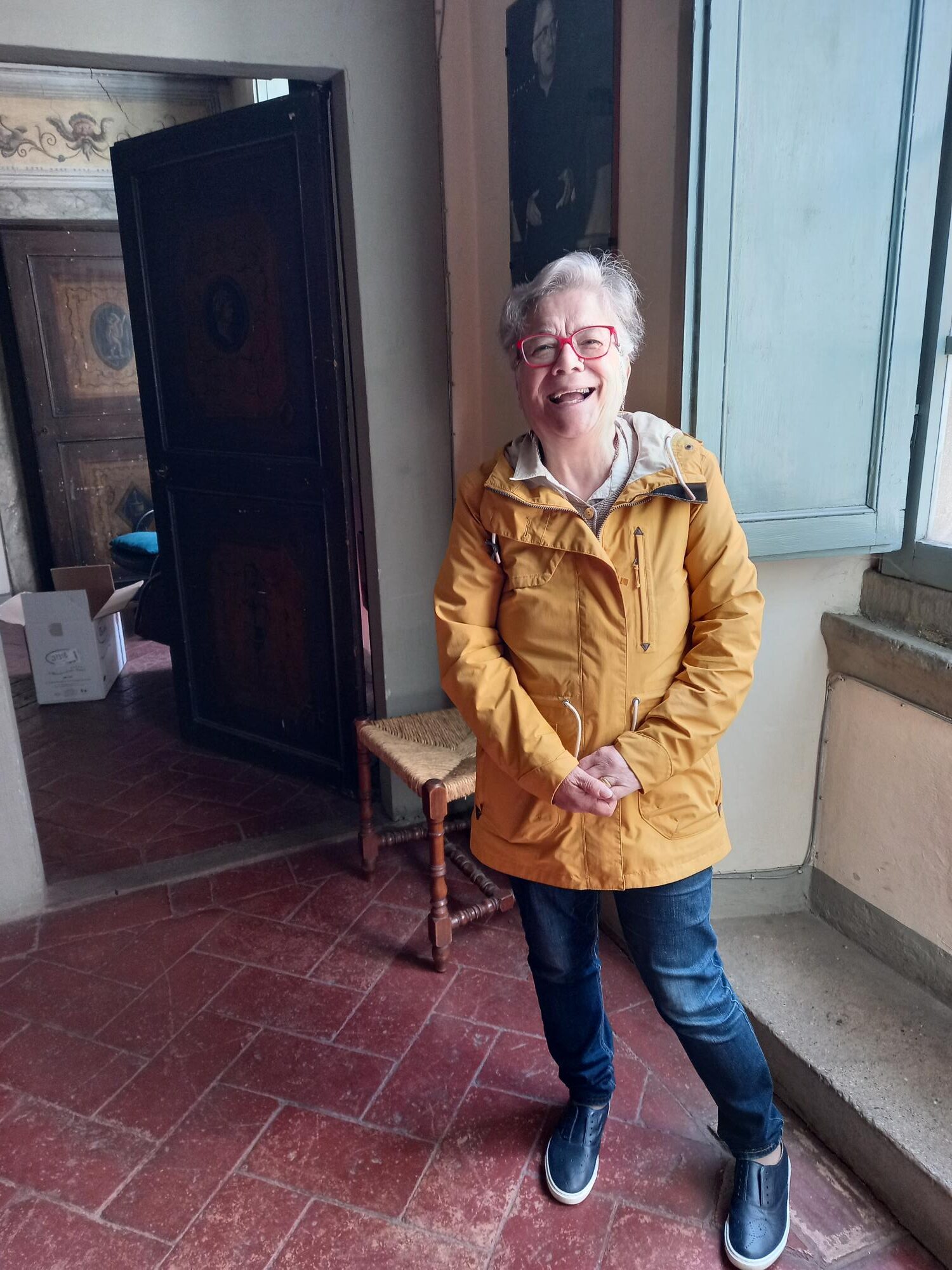
Appartenenza ad Anghiari – Elida Anna Bianchi
Circa un anno fa Elida ha chiuso la sua merceria, ‘Gaby 50’, situata appena fuori una delle porte del centro medievale. L’ho incontrata nel 2024 quando, su suggerimento della mia vicina Fiammetta, sono andata a comprare delle ‘farfalle’ per coprire dei buchi su un mio maglione. Già da lontano, mentre mi avvicinavo al negozio, ho visto Elida seduta fuori su una panca che mi sorrideva come se mi stesse aspettando. Ho pensato che Fiammetta le avesse detto che sarei andata, ma no! Quando le ho fatto vedere i buchi dicendo con tono interrogativo ‘farfalle’, sapeva esattamente cosa volessi!
Ho intervistato Elida nell’ACS (Anghiari centro studi), dove, mi ha poi spiegato, aveva abitato Don Nilo, una figura molto ammirata nella storia di Anghiari. L’intervista che si è svolta in italiano è stata poi trascritta e tradotta in inglese da Mirella Alessio. Questa è una versione editata.
Io sono nata a Eva Peron in Argentina il 12 marzo 1953. La mia famiglia è sempre stata una famiglia di migranti, la mia bisnonna paterna, Elvira, era già nata a Buenos Aires nel 1902. Però la famiglia è proprio anghiarese anghiarese, ma il babbo della mia nonna partì perché a quell’epoca la miseria…. Perché sono nata in Argentina? Mia mamma aveva una zia che aveva sposato sempre uno di Anghiari, ma che erano partiti per l’Argentina nel 1910. Venivano su, ritornavano… erano una famiglia che stava bene: ‘Vuoi venire in Argentina Gabriella con tuo marito?… il lavoro…’. I miei facevano gli ambulanti di merceria, avevano il banco, però nel dopoguerra la vita era molto misera. Così partirono, stavano benissimo! Negli anni ’50, per esempio, trovarono il frigorifero, cosa che qui nel paese non c’era, molti non avevano l’acqua in casa. Stavano molto bene, mia mamma stava in casa con la zia, mio babbo lavorava, faceva l’idraulico con lo zio che aveva tutti questi appalti per metter su acqua, termosifoni.
Nel settembre ’54 mio babbo decise dalla mattina alla sera di tornare in Italia. E fu la sua, la nostra fortuna perché, quando arrivarono a Casablanca, cadde il governo Peron e quindi il pesos non valeva più niente, ma mio babbo aveva cambiato prima i pesos in lire. Nel frattempo, i miei nonni avevano messo su il negozietto che la mia mamma aumentò, cambiò la veste. La casa sopra non era nostra, in quell’epoca abitavamo a Villa Fiesolina.
Ho fatto la scuola qui e poi sono andata al liceo scientifico a San Sepolcro, un bell’istituto, concreto, materie umanistiche, matematica, fisica… esiste ancora, il Liceo scientifico Piero della Francesca. Dopo quello sono andata all’università a Firenze, mi sono iscritta a Biologia, una materia che mi piaceva tantissimo, ma ho lasciato quando avevo solo 3 esami più la tesi. Ho scelto di aiutare i miei, per scelta, i miei non mi hanno mai detto: ‘fai questo, fai quest’altro’.
Mi sono sposata nel 1976, quest’anno faccio 50 anni di matrimonio. Abbiamo due figli Elena e Federico. Federico è sposato e in questo momento abita a Figline perché deve sistemare la sua casa ad Anghiari. Lavora nella ditta Forval con suo zio – fanno catene d’argento, d’oro. Elena abita ad Anghiari, ha fatto l’Accademia linguistica e quindi è nell’ufficio estero della Tratos Cavi, la ditta fa cavi, fibre ottiche in tutto il mondo.
Il mio legame con Anghiari nasce da quando siamo piccini, perché si gioca per le strade con gli amici. All’università stavo a Firenze durante la settimana però tornavo in speciali occasioni, come quando fu organizzato il Carnevale, Don Nilo ci chiamò, il Carnevale è nato in chiesa… eravamo giovani, a quell’epoca frequentavamo l’Oratorio da poco inaugurato, sarà stato nel ’66, c’era una sala cinematografica – Don Vittorio aveva preso questa macchina.
Per il paese è sempre stata molto importante la Chiesa, e grazie soprattutto a Don Nilo. Era un visionario, aveva una visione lunga dei giovani, ma ha centrato anche l’economia del paese. Ho un esempio personale: negli anni ’60 – ’70 non c’era la miseria perché con i campi si mangia, si fa baratto, si fa economia circolare. Ma lui incoraggiò i miei fratelli a mettere su una piccola fabbrichetta orafa… ‘cosi i giovani si fermano, non vanno fuori a cercare’.
Sento profondamente il mio legame per il paese perché la mia mamma, il mio babbo, tutti, mio nonno, si sono sempre calati nelle necessità degli altri. Quando c’era qualcosa da fare, bisognava fare, vai vai, fai, fai. Il mio volontariato è nato fin da giovanissima. Ho cominciato nel 1967, ci fu una fiera di armi antiche, avevo quattordici anni, mi hanno chiamata a fare la cassiera. Da allora dove mi han chiamata ho sempre detto di sì… forse una predisposizione e poi con il tempo è diventata diciamo una vocazione.
Il volontariato per la gente qui è importante, tantissimo. Hai visto quante associazioni ci sono nel paese? È una passione innata. Mio marito l’ho incontrato su un campo di calcio perché lui giocava e poi da lì è partita la passione per la Baldaccio Bruni, che era una piccola squadra, poi abbiamo cercato di inserire un po’ i giovani, fare il settore giovanile che è ancora attivo, sono 44 anni anche grazie all’aiuto degli altri, perché se tu non hai l’aiuto degli altri non fai niente, anzi è più riconosciuto il lavoro che un’offerta di soldi.
La specialità di Anghiari è l’amicizia, la bellezza, l’appartenenza: all’associazione sportiva, alla devozione per la Madonna di Loreto. Ancora oggi alzo gli occhi, vedo qualcosa che non avevo visto prima, tante volte mi meraviglio a qualche vista, ogni giorno ti riscopri… fa parte dell’animo. Chiudo gli occhi, posso rivedere la mia mamma seduta fuori dal negozio mentre ricamava, che mi piaceva tanto – mi rivedo in lei, come se fossi in simbiosi. Di speciale ci sono le persone che non ci sono più, ma che sono rimaste, è speciale che le persone sono sempre molto accoglienti, disposte a rispondere, ad aiutare se si può. Questa bellezza in città non esiste più, e anche qui sta svanendo, pianino pianino, è finita con le persone di una certa età. Però io confido che questa specialità venga portata avanti dai figli, perché se uno glielo insegna che bisogna essere sempre gentili, essere accoglienti, volere bene al paese e riconoscere, denunciare se qualcosa non va.
Il paese ha contribuito alla sicurezza, si poteva uscire, tranquilli e sereni, si giocava a pallone, si tornava, non ti sentivi mai in pericolo, e se magari ti vedevano in pericolo chi passava ti aiutava. L’appartenenza è questo, sentirsi protetto. Il senso di sicurezza viene anche dall’aver qualcuno che mi chiede se sono in difficoltà con le borse della spesa.
Il paesaggio è meraviglioso grazie alla posizione del paese in alto e al centro della Valtiberina. Gli anghiaresi hanno un motivo per il campanilismo – il panorama della vallata, i campi tutti verdi, colorati, ognuno c’è una semina, e poi i boschi, in una giornata di sereno arrivi a vedere i monti Sibillini con la neve, sono bellissimi anche quelli.
Faccio delle camminate, molto spesso, potrebbe sembrare lugubre, ma vado al cimitero per rivedere le persone che non ci sono più… i ricordi riaffiorano. Penso a nonnino, vive in me, quest’uomo di una grande, grandissima cultura, veniva da una famiglia quasi nobile, ma con il senso della cultura. I viaggi che io da piccina ho fatto, lui ci portava in giro, la Francia, l’Ungheria, l’Europa l’abbiamo girata, vedendo cose antiche, la bellezza del passato. Mi ricordo come si illuminava quando si fermava a questi mercatini dell’antiquariato in Francia. E poi c’è la Novella Ceppodomo, abitava di fronte a me e faceva Tovaglia a quadri, la memoria storica di alcune famiglie se io la conosco è grazie a lei. Mi raccontava del palazzo Testi, [ora sede della LUA, Libera Università dell’Autobiografia] quando ci vivevano 30 famiglie, ci stava anche lei con i suoi genitori… ricordi bellissimi.
Ricordo quando andavo all’asilo, anche lì sempre la Novella sulla porta ti chiamava per nome, la maestra Linda ci insegnava a fare le stuoie, giocavamo a nascondino, alla campana, alla corda, quando eravamo in tanti saltavamo tutti insieme, ci mettevamo il nome: Susina. Pesca. Pera. E poi palla, prigioniera, al muro, ci si divertiva così tanto!
Ho sempre riempito il non far niente facendo qualcosa, ricamo, lavoro ai ferri, ma leggendo soprattutto. Mia nonna leggeva Le Mille e una notte, I Viaggi di Gulliver, sto leggendo in francese L’étranger, mi piacciono i gialli, Camilleri, Grisham che rappresenta la giustizia come dovrebbe essere. Soprattutto con l’età posso rileggere qualche passo dei Promessi Sposi, della Divina Commedia, ogni tanto mi vengono in mente delle frasi. Mi piace anche la filosofia, la storia, invecchiando, le cose che mi hanno formato come persona.
Mi manca il mio negozio, mi manca, manca il contatto umano – io cercavo certo i clienti ma anche il contatto umano, però cerco di ovviare uscendo, stando in panchina, incontrando persone. Ho fondato Il covo delle ragazze; io di fronte al negozio ne ho un altro e il sabato, verso le 5.30, ci ritroviamo e ci si racconta gli eventi del paese…. Conosco una persona, hai sentito dire…? ti do indirizzo… si passa quell’ora e mezza bellissima per ovviare alla chiusura del negozio che ho amato profondamente.
Con la chiusura dei piccoli negozi di quartiere si è perso così tanto, sono la ricchezza di un paese ma anche di un quartiere, di una città. Finiscono i rapporti interpersonali, in un negozio di quartiere come il mio entrava una persona per chiedere un consiglio, che poteva riguardare un oggetto, ma qualche volta in questo mondo digitale persone di una certa età chiedevano aiuto per il cellulare, il computer: ‘come si fa a fare questo?’… il negozio di quartiere era fondamentale, ma non solo. Noi ci si conosceva, abbiamo sempre avuto la vigilanza del giovane, fino a poco tempo fa.
Quando qualcuno entrava nel mio negozio sentiva che il mio benvenuto aveva un calore insito, autentico, io sono così di natura. Speriamo di poter salvare l’incontro autentico, il colloquio, parlarsi onestamente, guardandosi negli occhi.
Pochi giorni dopo ho di nuovo intervistato Elida per sapere di più della sua attività che ha avuto per 44 anni. Ci siamo incontrate nel ‘negozio ’dall’altra parte della strada dove tiene l’invenduto e che è diventato un magazzino per vari altri negozi – non sa dire ‘no’. Al suo posto adesso c’è un’agenzia di Wedding planner.
Il negozio è nato nel 1950, il nonno Lorenzo con la nonna Elvira l’hanno messo su. Loro erano già ambulanti, andavano per mercati, e si fermarono e comprarono un piccolissimo negozio, 20 mq. All’inizio vendevano aghi, fili, nastri, elastici, e piatti e bicchieri. Poi hanno acquistato i successivi magazzini a fianco, lo stagnino smise e comprarono anche quello, poi nel 1963, fu sistemata la casa sopra il negozio.
Mia mamma come gli altri in famiglia aveva studiato, aveva un diploma, il nonno amava far studiare le figlie, ma mio nonno le dette in mano l’attività del negozio perché lei vedeva come andava il mercato. Mia mamma ebbe l’idea di mettere qualcosa di intimo, abbigliamento, maglie, camicette, gonne e il mio babbo si dedicò all’articolo da regalo, oggettistica, giocattoli. È andato avanti per tanti anni lavorando anche bene, si lavorava tanto ma con soddisfazione, non solo economica, ma anche di persone che venivano, erano contente. Si poteva dare la merce a rate, si facevano anche delle promozioni anche se la famiglia era conosciuta, sempre di qualità alta, però, sempre con uno sguardo al prezzo.
La merceria l’abbiamo tenuta: nastri, bottoni, spalline, aghi di vario tipo, per ricamare, per la lana, da macchina per cucire, per accomodare le reti delle olive, ferri per maglie, uncinetti, la profumeria. Vendevamo anche quaderni per i ragazzi, passavano davanti per andare a scuola. Avevamo latte di metallo con un dispenser e si vendeva la brillantina, la schiuma da barba, la lacca per capelli, la cera rossa per pavimenti a mattoni, la varechina; i clienti venivano con le bottigline che si portavano da casa, c’era un riciclare senza buttare via. Il gran cambiamento arrivò con l’avvento del Moplen, la plastica sostituì tutto, la fine di un mondo.
La decisione di chiudere è avvenuta purtroppo per la prevalenza di grandi supermercati e per l’avvento dell’e-commerce. Comprare online ci ha ucciso e ha contribuito moltissimo la pandemia di Covid. Non si poteva aprire i negozi e la gente si è abituata all’online. Io ho potuto tenere aperto perché avevo i beni di prima necessità per i bambini, però abbiamo perduto. L’anno dopo della pandemia che ‘Tovaglia a quadri’ fu possibile rifarla c’è stata una commedia intitolata ‘Ci Amazon tutti’. La non cultura di chi è al comando, chiunque sia, non ha mai pensato che i piccoli negozi di quartiere erano quelli che facevano rete, stavano aperti al servizio della persona che passa, un posto illuminato, poteva essere la salvezza del bello. Senza di noi avanza il vandalismo, la delinquenza. E poi le tasse esorbitanti, un negozio piccolino come il nostro doveva pagare la stessa percentuale di Roma.
La piazzetta delle legne, il nome gliel’abbiamo messo noi anghiaresi perché il mercoledì, la gente faceva provvigione di bragina, carbonella da Toppoli, di fascine di piccoli rami e legna al quintale. È finito all’inizio degli anni ’60 perché le persone hanno comprato l’Ape, facevano il servizio a domicilio.
Il mio negozio ha una posizione strategica, da un lato si guarda in alto e si vede la chiesa della Prepositura, dall’altro c’è una vista sulla piazza principale da dove tutti potevano vedermi seduta sulla mia panca.
This year, I conducted interviews in the Palazzo Fontana, seat of the Anghiari Cultural Centre (ACS). Here is a description of the ACS by Renato Li Vigni:
ANGHIARI CULTURAL CENTRE
Between earth and sky in Tuscany APS (Social Promotion Association)
With a vision of culture as a driver of development of small villages in the Apennines, we promote the heritage of the territory for a better future for the next generations. Established in 2017, ACS is a non-party, non-profit association for social and cultural promotion, entered in the Third Sector registry.
WHAT WE DO
– VIDEO STORYTELLING AND CINEMATIC CULTURE: a permanent workshop of video storytelling, courses, festivals and meetings to spread cinematographic culture.
– THE TERRITORY OF THE ARETINO-EMILIANO-ROMAGNOLO APENNINES: a permanent workshop of land science under the supervision of Carlo Citter, Professor of Medieval Topography/ UniSI; research and promotion of the archaeological site of Sestino Romana; research on the network of paths and transhumance roads (Communes of Sarsina, Verrucchio, Badia Tedalda, Sestino, Anghiari, Monterchi, Sansepolcro).
– BOOK COLLECTIONS AND DOCUMENTS. In our offices in Palazzo Fontana, we preserve two important book collections: Maurizio De Benedictis – film history and criticism; and Giovanni Caselli – anthropology and archaeology of the landscape.
Belonging in Anghiari – Elida Anna Bianchi
About a year ago, Elida closed her haberdashery shop, ‘Gaby 50’, located just outside one of the gates to the medieval centre. I met Elida in 2024 when, on the suggestion of my neighbour, Fiammetta, I went to buy ‘butterflies’ to cover holes in a jumper. From some distance, as I approached the shop, Elida, sitting on a bench outside, was smiling at me as if she were expecting me. I thought that Fiammetta must have let her know that I was coming, but no! When I showed her the holes and said, rather quizzically, ‘butterflies’, she knew exactly what I wanted!
I interviewed Elida in the ACS (Anghiari centro studi), which, she explained, had been the home of Don Nilo, a much-admired figure in Anghiari history. The interview was conducted in Italian, and transcribed and translated into English by Mirella Alessio. This is an edited version.
I was born in Eva Peron in Argentina on the 12th March 1953. My family was always a family of migrants – in 1902 my grandmother on my father’s side, nonna Elvira, was born in Buenos Aires. The family is true anghiarese, but my great grandfather left because of the extreme poverty at the time. How did I come to born in Argentina? Well, my mother had an aunt who, with her husband, moved from Anghiari to Argentina in 1910. They were well-off and travelled back and forth, and, on one of those occasions, they invited my mother, Gabriella, and my father to migrate because, at that time, there was more work Argentina. My parents had an itinerant stall selling haberdashery in markets, but life was hard here after the war. So, they left… they had a good life there. In 1950, for example, they had a fridge; here, in Anghiari, nobody had one, many houses didn’t even have running water. They had a comfortable life – my mother stayed at home with her aunt and my father worked with his uncle installing water pipes and heaters.
In September ’54 my father decided, overnight, to come back to Italy. It was good timing because, when they reached Casablanca, Peron fell and the pesos lost all its value. Fortunately, my father had already changed his into lire. In the meantime, my grandparents had set up a small shop which my mother expanded, changing the style. The house above the shop wasn’t yet ours – at the time we lived at Villa Fiesolina.
I went first to school in Anghiari and then I attended a science high school, Piero della Francesca, in Sansepolcro, which still exists – a good school with Latin, literature, history as well as science subjects. Then I enrolled at the University in Florence, in biology, a subject I really enjoyed, but I left before graduation. I chose to help my parents … it was my choice, I wasn’t under any pressure from the family.
I married in 1976, this year is our 50th wedding anniversary. We have two children, Elena and Federico. Federico is married and, at the moment, lives in Figline because he is fixing his house in Anghiari. He works in his uncle’s company, Forval – they make gold/silver jewellery. Elena lives in Anghiari – she studied foreign languages and now works in the export office at Tratos Cavi, a company that makes cables, optical fibres, selling all over the world.
My bond with Anghiari was born in childhood, playing in the street with friends. When I was attending university in Florence I lived there during the week, but I would come back for special occasions, like during Carnival – Don Nilo would call us, the Carnival started in the church … we were young, we attended the Oratorio, the parish youth club inaugurated around 1966, and there was a cinema – Don Vittorio had bought a projector.
The Church has always been important for the town, particularly thanks to Don Nilo. He was a visionary, and he had a long-term vision for young people…. He also understood the economic needs of the town. I have a personal example: in the ’60s,’70s there wasn’t real poverty – if one owned some land it was possible to survive with the produce, exchanging in a kind of circular economy – but he encouraged my brothers to start a small business producing jewellery… so the youngsters didn’t have to leave home, to go away looking for work.
I also feel a deep bond with the town because my mother, father, everybody in the family, my grandfather, had always been very aware of other people’s needs. When there was something to do, we had to go, go, do, do.
From an early age, I have done volunteering. It started in 1967: there was the antique weapons fair, I was 14, and they asked me to help at the cashier. From then, if someone has called me, I have always said yes …perhaps it was a predisposition, then it became almost a vocation. Volunteering is very important for the people here – have you noticed how many volunteering associations there are? It’s an innate passion…. I met my husband on a soccer field – he was a player and, from there, the passion for the Baldacci Bruni started – a small team … we tried to involve boys in a youth team which is still active after 44 years thanks to the help of others. Without this help, you can’t achieve anything – the practical support is more appreciated than a money donation.
The special thing about Anghiari is friendship, beauty, and belonging, to a sport association, to the devotion to the Madonna di Loreto…. I still raise my eyes and see something I have never seen before – I marvel at a sight, every day I rediscover… it is part of the soul. I close my eyes and I can see again my mother sitting outside the shop embroidering – I really liked it…. I see her in myself, almost like a symbiosis …. It is special that people who are not with us anymore are still here; it is special that people are always welcoming, ready to answer – if possible, we do things for each other. It is a kind of beauty that in big cities doesn’t exist anymore, and here too is waning, slowly slowly, with the disappearance of people of a certain age…. I hope that this special attitude is carried along by the new generation … if we teach our children to be kind, to be always welcoming, to love the town and to recognise if something is wrong.
The town has always felt safe to me …you could go out in total tranquillity and serenity … we played soccer, went back home, we never felt in danger, and if a passer-by saw us in any danger they would help. Belonging means this, feeling protected. A sense of security also comes from having someone to ask if I need help with the shopping bags…
The landscape is wonderful thanks to the position of the town high up in the centre of the Valtiberina. The anghiaresi have a reason for their campanilismo – the view of the valley, the fields green, in all colours according to the various cultivations, the woods, and, on a clear day, it is possible to see the Monti Sibillini covered in snow. It is all very beautiful.
I go for long walks. It might seem grim, but I often go to the cemetery to see the people who are not here anymore…memories resurface. I think about nonnino, my grandfather – he still lives in me, this man with a vast education; he was from an almost aristocratic family, with a feeling for culture. I travelled a lot as a child with him- he took us to France, Hungary, we toured Europe, seeing ancient things … the beauty of the past lives on. I remember his face lighting up when we went to antique markets in France. Then there is Novella Ceppodomo who lived opposite us … she was involved in Tovaglia a Quadri. Thanks to her I learnt the history of some families – she told me about palazzo Testi [the current location of LUA, the Free University of Autobiography] where 30 families, including hers, lived. …beautiful memories.
I remember going to kindergarten, Novella standing in the street at the door would call us by name. Teacher Linda taught us wicker weaving…. And we played…hide-and-seek, hopscotch, and when there were a lot of us, we used a long rope and skipped all at the same time… we gave each other nicknames, Plum, Peach, Pear. And then all the games with a ball, throwing it against a wall and taking turns at catching it, dodgeball. We had so much fun!
I have always filled my spare moments doing something – sewing, knitting, but mainly reading. My grandmother read to me – One thousand and one nights, Gulliver’s Travels …. I’m reading in French L’étranger, and I like crime novels, Camilleri, and Grisham who speaks of justice as it should be.…. Above all, with age, I can reread passages of I Promessi Sposi, La Divina Commedia… and, every time, the phrases come back to me. I also like philosophy, history – as I grow older, the things that formed me as a person.
I miss my shop, the human contact – of course I wanted clients, but it was mainly the contact, sitting on a bench, meeting people. I have now founded ‘The girls’ den’. I have another shop across from the old one and we meet there every Saturday at 5.30 pm – we talk about what’s happening in town, we exchange tips, addresses … a beautiful hour and a half to deal with the closing down of the shop I loved so deeply.
With the closing down of small neighbourhood shops so much is lost – they are the richness of a village, but also of a suburb in a city. There’s the loss of interpersonal relationships – in a local shop like mine people came in to ask advice, perhaps regarding an object, but sometimes, in this digital world, old people asked for help on how to do things on the phone, the computer… small shops were fundamental … also, because we knew each other, we kept an eye on misbehaving youngsters.
When someone came into my shop my welcoming was innate, warm, authentic… it is my nature. I hope we can preserve authentic encounters… the conversation, speaking honestly, looking each other in the eyes.
A few days later, I did a further interview with Elida to hear more about the shop that she owned for 44 years. We met in the ‘shop’ opposite where she stores unsold goods and which has also become a repository of unwanted items from local businesses – she can’t say ‘no’. Her ex-shop is now the office of a ‘weddings planner’ (in English) company.
The shop was opened by nonno Lorenzo and nonna Elvira in 1950. They already had an itinerant stall… then they bought a very small shop, 20 square meters. At the beginning, they sold articles for sewing and knitting, elastic strings, plates and glasses. Then, they bought a neighbouring warehouse and a tinsmith shop that had closed, and then, in 1963, they fixed the apartment above the shop.
My grandfather left the shop to my mother. Like others in the family, she had a diploma – my grandfather believed in girls’ education …but he saw in her a special talent in understanding the market. She started selling underwear, clothes, shirts, skirts and my father dedicated himself to gift items and toys. The shop went on for many years and did very well – there was a lot of work, but very satisfying, not only financially, but also because the clients were happy. We sold on instalments and did promotions even if our name was already established… the quality was always high, but with an eye to the price.
We kept the haberdashery, needles for hand and machine sowing and for repairing the nets for olive harvesting, buttons, crochet hooks, perfumes. We sold exercise books for children passing by on their way to school. We had dispensers with brilliantine, shaving cream, hairspray, floor polishing wax and bleach; customers came with their own bottles for refills – we recycled, without throwing anything away. The big change came with Moplen, when plastic substituted everything – the end of a world.
The decision to close was a result of the prevalence of supermarkets and the arrival of e-commerce. Online buying killed us and the Covid pandemic contributed a lot – with shops being closed, customers got used to buying online. We were able to stay open during the pandemic because we had items for children, but we still lost a lot. The year after, the title of the Tovaglia a Quadri performance was ‘Ci Amazon tutti’ [they kill all of us; ammazzare = to kill]. Nobody in government understood the importance of the network of the local shops – we provided a service to people, our windows lighted up the streets, we saved beauty, without us there is more vandalism, delinquency. Taxes are not proportionate with the size of the shop, we pay like the big ones in a fashionable street in Rome.
The Piazzetta delle legne [the name given by the community to the small piazza outside the shop] was named like that because of the special Wednesday sale – it was a separate market where people stocked up with embers produced in Toppoli and small bundles of twigs and firewood. It discontinued in the early ’60s because the producers bought Ape cars and would do home deliveries.
My shop had a strategic position – on one side, you look up to La Propositura [the main church], on another, there is a view of the main square from where everyone could see me, sitting on my bench.